 blog
Is Tri-Town Construction the Right Condo Remodeler for You?
Last Updated: October 25, 2026
Quick Summary
Tri-Town Construction is a legitimate general contractor for condo remodeling, but you should compare it against alternatives on condo-specific experience, association approvals, contract terms, delay penalties, and license verification. Force every bidder, including Tri-Town, onto the same four-bucket line-item estimate so your comparison is apples to apples.
- Ask each contractor to price labor, condo logistics, compliance, and contingency separately.
- The contractor should own the association approval chain, not you.
- Late material selections and slow association approvals wreck timelines most.
- Verify the license number with the state yourself before signing.
- Accent offers fixed-price contracts on most projects under $1.5 million.
Table of Contents
- How Tri-Town Construction Compares for Condo Remodeling
- Condo Remodeling Costs and What Drives Your Estimate
- Your Condo Remodeling Estimate Checklist
- Condo Association Renovation Requirements You Must Clear
- A Realistic Condo Renovation Timeline, Start to Finish
- Questions to Ask a Remodeling Contractor Before You Sign
- Request Your Condo Remodeling Quote from Accent Construction
- Frequently Asked Questions
How Tri-Town Construction Compares for Condo Remodeling
Tri-Town Construction is a legitimate general contractor option for condo remodeling, but it is not the only one worth evaluating before you sign. The Harvard Joint Center for Housing Studies projects only 2.1% year-over-year growth in home renovation spending by mid-2026, per its Leading Indicator of Remodeling Activity, which means contractors are competing harder for your project, and you have more use to ask hard questions.
At Accent Construction & Remodeling, we have watched condo owners get burned by the same three problems: vague scopes, surprise change orders, and contractors who underestimate association requirements. Below, we break down how Tri-Town stacks up, what your estimate should actually contain, and how to compare any remodeler fairly.
Here is the core tension: a contractor's general residential experience does not automatically translate to condo work. Shared plumbing, electrical and mechanical systems, elevator access, and common-area protection change the entire construction plan, as Moss Design's condo renovation guidance points out. For a dedicated alternative, see our condo and high-rise remodeling services, including HOA and fire-inspector coordination.
Our take: evaluate Tri-Town, or any contractor, on five things, condo-specific experience, how they handle association approvals, what their contract says about delays, how they price, and whether you can verify their license. That is the whole game.
| Evaluation Factor | What to Look For | Why It Matters |
|---|---|---|
| Condo-specific experience | High-rise and association projects in portfolio | Shared systems change the build plan |
| Association handling | Contractor manages HOA and fire inspection | Saves you from being the messenger |
| Contract type | Fixed price with defined change-order process | Protects your budget |
| Delay consequences | Written penalties for missed deadlines | Protects your schedule |
| License verification | Active state license and insurance | Protects you legally |
Condo Remodeling Costs and What Drives Your Estimate
Condo remodeling costs depend on scope, unit condition, building access rules, and how much of the work touches shared systems. If you want to understand how contract structure changes what you actually pay, this comparison of fixed price versus cost plus remodeling is worth reading before you collect bids.
A practical way to benchmark is to separate the estimate into four buckets and ask each contractor to price them separately:
- Direct construction labor and materials. Demo, framing, drywall, electrical, plumbing, tile, cabinetry, paint, and finish carpentry. This is the only bucket most homeowners compare, and it is usually the least variable between competent bidders.
- Condo logistics. Elevator reservations and padding, corridor and lobby protection, daily debris removal, dust containment, loading-dock scheduling, and after-hours work premiums. In a high-rise, these items can add meaningful labor hours that a single-family bid never carries.
- Compliance and approvals. Permit fees, plan review, association application fees, fire marshal inspection, and any engineering letters required for system tie-ins. Ask who pulls the permit and whether the fee is passed through at cost or marked up.
- Contingency and allowances. A defined contingency for concealed conditions (especially in older buildings) and labeled allowances for tile, fixtures, and cabinetry, with a written rule for what happens when selections exceed the allowance.
What drives the number up or down:
- Scope depth. A cosmetic refresh (paint, flooring, fixtures) versus a full interior renovation with moved walls and new plumbing are different projects entirely. Moving a kitchen sink or adding a bathroom means touching vertical plumbing stacks, which requires coordination, sometimes a building engineer's review, and occasionally a shutoff window that affects neighboring units.
- Building access. Elevator reservations, work-hour restrictions, and loading dock rules add labor time. A building that allows work only between certain hours, or requires a COI naming the association before a vendor can enter, changes the scheduling math.
- System tie-ins. Shared plumbing, electrical, and mechanical systems mean any change to them needs building approval and a plan for isolating the work from other residents.
- Protection and cleanup. Corridor and elevator protection, daily debris removal, and dust containment are real line items in a high-rise, not overhead a contractor should bury.
- Permit and inspection fees. These vary by jurisdiction and should be itemized, not lumped in.
A common mistake is comparing bids on the bottom-line number alone. Two estimates can differ by tens of thousands and still both be "fair," because one excludes permits, protection, or a contingency the other includes.
Your Condo Remodeling Estimate Checklist
A condo remodeling estimate should be a written, itemized document you can compare against other bids, not a one-page total. Use this checklist when you review any contractor's proposal, including Tri-Town's:
- Scope of work broken out room by room, with materials specified
- Demo and disposal costs listed separately
- Permit fees and who pulls the permit
- Common-area protection and daily cleanup included
- Elevator reservation and work-hour costs addressed
- Allowances clearly labeled, with what happens if you exceed them
- Change-order process in writing, including who approves and how pricing works
- Payment schedule tied to milestones, not calendar dates
- Start date and completion date stated
- Delay penalties or remedies defined
- Warranty terms on labor and materials
- License number and insurance certificate attached
Watch out: the most common trap is an estimate with large "allowances" for tile, fixtures, or cabinetry. An allowance is a placeholder, not a price. If the allowance is low, the final bill climbs. Ask what happens when you go over, and get it in writing.
Condo Association Renovation Requirements You Must Clear
Condo association renovation requirements typically include an application and approval process, proof of contractor insurance, defined work hours, elevator and common-area rules, and sometimes a fire marshal inspection before sign-off.
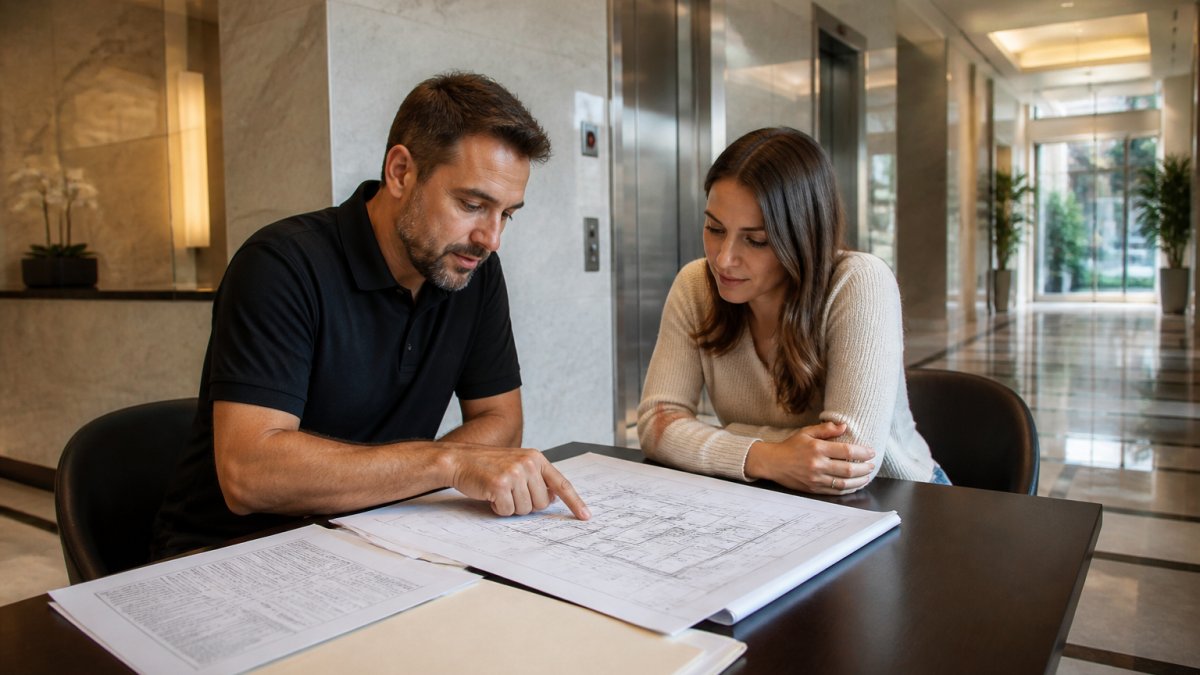
Most associations require some combination of:
- A renovation application with plans and contractor information
- Certificates of insurance naming the association as additional insured
- A refundable damage deposit
- Approved work hours and quiet periods
- Elevator protection and reservation scheduling
- Debris removal and dumpster placement rules
- Final inspection sign-off, sometimes including a fire marshal walkthrough
The part most owners miss is the sequence. Approval is not a single form; it is a chain, and each link has an owner:
- Pre-application review. The contractor reviews the building's alteration agreement and rules before you sign anything. If the contractor has not read the building's rules, they cannot price the logistics correctly.
- Plan and document submission. You or the contractor submits plans, the contractor's license and insurance, and any engineering letters for system tie-ins. The contractor should prepare this package, not you.
- Board or management review. This is the waiting step, and it is where timelines slip. Ask the contractor how they follow up and whether they have a named contact at the management company.
- Pre-construction coordination. Elevator reservations, protection installation, work-hour confirmation, and vendor COI delivery to the building. This is the step that separates a contractor who has done high-rise work from one who has only done houses.
- Inspection and sign-off. Fire inspection if required, punch list, deposit return, and final association sign-off.
The contractor should own this process, not you. If you are the one forwarding emails between the building manager and the superintendent, something is wrong.
For a deeper walkthrough of how approvals work in this market, read our guide on managing condo renovation in Southwest Florida.
A Realistic Condo Renovation Timeline, Start to Finish
A condo renovation timeline usually runs from several weeks for a cosmetic refresh to several months for a full interior remodel, with association approval adding time before construction even begins.
Here is the sequence that actually happens:
- Design and scope, finalize plans, selections, and budget.
- Association approval, submit the application, insurance, and plans; wait for board review.
- Permitting, pull required permits through the jurisdiction.
- Pre-construction, schedule elevator access, protection, and delivery windows.
- Construction, demo through finish work, with inspections along the way.
- Final inspection and walkthrough, fire inspection if required, punch list, sign-off.
Two things wreck timelines more than anything else: late material selections and slow association approvals. Both are avoidable with planning. If schedule protection matters to you, understand how penalty clauses for construction delays work before you sign anything.
Questions to Ask a Remodeling Contractor Before You Sign
The questions to ask a remodeling contractor before signing come down to five areas: license and insurance, condo experience, contract terms, delay consequences, and who actually runs the job. Ask them in person and write down the answers.
- "Are you licensed and insured, and can I see the certificate?" Verify the license number with the state yourself.
- "How many condo or high-rise projects have you completed?" Ask for addresses or references you can check.
- "Who manages the association approval and fire inspection?" The answer should be the contractor.
- "Is this a fixed-price contract, and what triggers a change order?" Get the change-order process in writing.
- "What happens if you miss the completion date?" Look for real consequences, not reassurances.
- "Who is on site daily, and who is my point of contact?" If the owner is only a name on the letterhead, ask who actually runs the job.
- "Can I see 3D renderings before construction starts?" Visual planning reduces costly mid-project changes.
Watch out: a contractor who answers "we handle all that" without specifics on the association process is telling you they have not done it much. Ask for a recent example.
Request Your Condo Remodeling Quote from Accent Construction
Tri-Town may be the right fit for some projects, but if you want a contractor who treats condo work as its own discipline, we would like to earn that comparison.
The challenge is simple: most condo owners only discover what their contract actually says when something goes wrong. Get the scope, the schedule, and the consequences in writing before you commit.
Frequently Asked Questions
How long does a typical condo remodel take?
Most condo renovations run longer than a single-family project of the same size because of building rules. A realistic condo renovation timeline starts with two to six weeks for association approval before any work begins, then construction time based on scope. Kitchens and bathrooms each commonly take several weeks once permits clear, and whole-unit remodels stretch further. Elevator reservations, work-hour limits, and shared-system shutdowns add days you should build into the schedule up front.
What should I compare when choosing a condo remodeling contractor?
Compare four things: proof they have worked in high-rise and condo buildings, how they handle association approval and building logistics, whether pricing is fixed or open-ended, and what happens if they miss a deadline. Ask for project photos from occupied buildings, not just finished shots. Confirm licensing and insurance in writing, and read independent customer reviews. A contractor with strong residential remodeling experience but no condo-specific work may underestimate elevator access, shared plumbing, and inspection timing.
How do condo association rules affect a remodeling project?
Condo association renovation requirements can shape your entire project. Associations commonly limit work hours, require elevator pads and reservations for material transport, restrict noisy work to certain days, and demand proof of contractor insurance before issuing approval. Some buildings require board review of plans, and structural or plumbing changes may need engineer sign-off. Read your governing documents before you get estimates, because a design that ignores these rules may need revisions after approval.
What is the 30% rule in remodeling, and is it useful for a condo project?
The 30% rule is a budgeting habit that sets aside about 30% of your project cost for surprises and upgrades. It is a rough guideline, not a standard. For a condo remodel, that cushion is more useful for unknowns like hidden water damage behind old tile or a required upgrade to shared plumbing. A fixed-price contract reduces how much of that reserve you actually spend, but keeping some aside still protects you if the association requires changes mid-project.
Get started with Accent Construction & Remodeling and request a free, no-obligation consultation for your condo project. Let's talk about your project, call (239) 217-4177 or send us a message, and we will walk you through scope, approvals, and a fixed-price estimate.