 How-to
Can You Avoid Surprise Costs During Home Renovation?
Last Updated: October 28, 2026
Quick Summary
You can avoid surprise costs during home renovation by setting aside a contingency fund before you sign anything, since most overruns are predictable. Start your reserve at 10%, add 5% for each high-risk factor, and cap it at 20% unless the home has active structural or water problems.
- 39% of homeowners still blow past their budget because of unexpected costs.
- 54% of homeowners cite high costs as the main obstacle to renovating.
- Cosmetic updates usually need a 10% contingency, while kitchen or bath gut renovations should aim for 15%.
- Older homes or structural work should hold a 20% contingency.
- A contingency is not a spending target; finishing with the reserve intact is a successful project.
Table of Contents
- Why Surprise Costs Sink Home Renovation Budgets
- Hidden Costs That Appear Once Walls Come Down
- Build a Home Renovation Cost Estimate Checklist Before You Sign
- How Large Should Your Home Renovation Contingency Budget Be?
- Home Renovation Change Orders: How to Keep Them From Multiplying
- What a Fixed-Price Remodeling Contract Should Protect You From
- Request a Fixed-Price Quote From Accent Construction & Remodeling
- Frequently Asked Questions
Why Surprise Costs Sink Home Renovation Budgets
Avoiding surprise costs during home renovation starts with one hard truth: most overruns are predictable. The 2026 U.S. Houzz and Home Renovation Trends Study reports a median planned renovation spend of $15,000, down from $20,000 in 2025. Homeowners are planning tighter. Yet RubyHome's 2026 remodeling statistics show 39% of homeowners still blow past their budget because of unexpected costs. That gap between plan and reality is where projects fall apart.
The fix isn't luck. It's building the surprises into the budget before you sign anything.
The Numbers Behind Budget Overruns
Cost is the number one roadblock. According to the 2026 State of American Home Renovation report, 54% of homeowners cite high costs as the main obstacle to renovating, with 28% naming trouble finding trusted professionals. So the pressure starts before the first hammer swings.
A contingency fund is money set aside to cover costs you can't see yet. It is the single best defense against a budget overrun. Skip it and every hidden problem becomes a crisis.
Hidden Costs That Appear Once Walls Come Down
Hidden costs are the expenses a walkthrough can't reveal. They live behind drywall, under floors, and inside the fine print of local rules. Here's what can catch homeowners off guard.
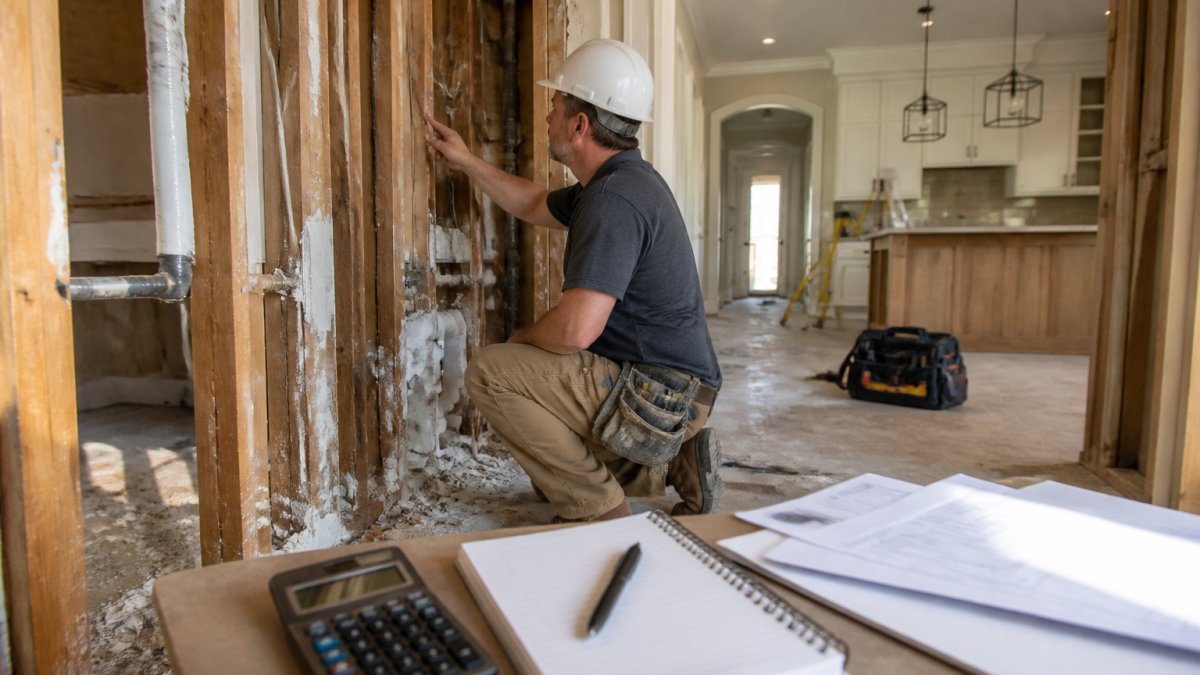
Structural Damage, Permits, and Disposal Fees
- Permits and inspections: plan-review fees, zoning fees, and building code compliance costs.
Upfront planning can help homeowners consider potential costs before signing.
Build a Home Renovation Cost Estimate Checklist Before You Sign
A home renovation cost estimate checklist can help organize questions to consider before signing:
- Line-item labor and material costs, not one lump sum
- Permit, inspection, and plan-review fees listed separately
- Demolition and debris disposal charges
- An allowance for fixtures, finishes, and design revisions
- A stated contingency
- A clear change-order process in writing
- A realistic schedule with milestones
For a deeper walkthrough of modeling your numbers, see how to budget for a luxury renovation.
How Large Should Your Home Renovation Contingency Budget Be?
A home renovation contingency budget is money set aside for unexpected project costs. The amount to reserve depends on the project.
Score Your Project Risk Before You Pick a Number
Rate each factor low, medium, or high, then set your reserve:
- Age of the home: pre-1980 homes carry more unknowns in wiring, plumbing, and framing; post-2010 homes carry fewer.
- Scope of work: cosmetic updates are predictable; gut renovations and structural work are not.
- Drawing quality: full architectural drawings and a 3D design reduce unknowns; a hand sketch does not.
- Known defects: a prior inspection that flagged water intrusion or an aging roof raises the reserve.
- Material lead times: long-lead custom cabinetry and windows raise the risk of price and schedule drift.
A simple rule most practitioners use: start at 10%, add 5% for each high-risk factor, and cap at 20% unless the home has active structural or water problems, in which case a pre-construction inspection is cheaper than a bigger buffer. These same principles of contingency planning apply to waterfront properties, where the volatility of marine construction costs necessitates an even more rigorous approach to site assessment.
- Cosmetic updates: 10% is usually enough
- Kitchen or bath gut renovations: aim for 15%
- Older homes or structural work: hold 20%
- Waterfront or high-rise units: lean toward the top of the range
Track Committed, Paid, and Forecast Costs
A buffer is easier to monitor when you track project costs. Consider keeping a log of committed, paid, and forecast costs.
A budget buffer is money set aside for potential unexpected costs.
The reserve to set aside depends on the project, and these starting points match the risk factors above.
| Project type | Contingency | Note |
|---|---|---|
| Cosmetic updates | 10% | Usually enough |
| Kitchen or bath gut renovations | 15% | Aim for this level |
| Older homes or structural work | 20% | Hold the top of the range |
| Waterfront or high-rise units | Top of the range | Lean toward the top |
| General rule | Start at 10% | Add 5% per high-risk factor |
| General rule cap | 20% | Unless active structural or water problems |
Home Renovation Change Orders: How to Keep Them From Multiplying
Home renovation change orders are written amendments to the scope, price, or schedule after work begins.
To manage change orders, consider documenting proposed changes and reviewing their cost and schedule implications before approval. For schedule slips, see this guide to penalty clauses for construction delays.
What a Fixed-Price Remodeling Contract Should Protect You From
A fixed-price remodeling contract sets a price for defined work.
Contract terms can address the project scope, pricing, change orders, schedule, and material substitutions.
We build fixed-price contracts for most projects under $1.5 million, backed by an on-time completion guarantee with self-imposed penalties. To weigh your options, read our fixed-price vs cost-plus comparison.
Request a Fixed-Price Quote From Accent Construction & Remodeling
A written price can help clarify the cost of defined work. Accent Construction & Remodeling is led by founder John Pelland, with over 35 years of trade experience and owner-led project management. We handle HOA coordination for high-rise and condo projects, and we offer 3D design planning for home renovations and additions.
Explore our home renovations for waterfront projects, or book a free consultation to talk through your budget.
Frequently Asked Questions
What are the most common unexpected costs in a home renovation?
Potential unexpected costs can include hidden structural damage, permit and inspection fees, material price increases, demolition and debris disposal, and design revisions that trigger change orders. A cost estimate checklist and a contingency fund can help homeowners plan for potential unexpected costs.
How much should I set aside for a home renovation contingency budget?
The amount to set aside depends on the project. Consider the scope and any known conditions when planning for potential unexpected costs.
How can I avoid change orders during a remodel?
Defining the scope before construction starts can help clarify the planned work. Accent Construction & Remodeling offers 3D design planning for home renovations and additions. Discuss how changes to the scope, price, or schedule will be handled before work begins.
What should a home renovation contract include to prevent surprise costs?
Review the scope of work, pricing, change-order process, schedule, and how unforeseen conditions will be handled. Accent Construction & Remodeling offers fixed-price contracts for most projects under $1.5 million. Discuss the contract terms and any permit or inspection costs before work begins.
Surprises happen on every renovation. The difference is whether they're already in the budget. Get started with Accent Construction & Remodeling and lock in a fixed price before the first wall comes down.