 How-to
How to Hire a Contractor for a Naples High-Rise Condo
Last Updated: November 22, 2026
Quick Summary
Hiring a contractor for a Naples high-rise condo starts with your building's rules, not your bid list, because most associations require board approval before any work begins. Confirm the renovation rules and approval process with your association first, then verify the contractor's Florida license and insurance before accepting any bid.
- Gather your declaration, bylaws, renovation addendum, and board application before calling contractors.
- Run a Florida contractor license lookup on every bidder and confirm the license type covers your scope.
- Ask for a certificate of insurance naming you and, where required, the association as additional insured.
- Boards and architectural review committees often meet monthly, so a missed agenda waits a full cycle.
- Get board approval in writing before demolition and keep a copy on site.
Table of Contents
- Start With Your Building's Rules, Not the Contractor List
- How to Run a Florida Contractor License Lookup
- Insurance and Contract Checks That Protect a Naples High-Rise Condo Owner
- Questions to Ask a Remodeling Contractor Before You Sign
- A Condo Remodeling Contract Checklist for High-Rise Units
- Building a Realistic Condo Remodeling Project Timeline
- Comparing Bids and Locking In a Fixed Price
- Request a Free Quote From Accent Construction & Remodeling
- Frequently Asked Questions
Start With Your Building's Rules, Not the Contractor List
Hiring a contractor for a Naples high-rise condo starts with your building, not your bid list.
This guide walks through the order that works for condo projects: building rules first, license and insurance verification second, bids and contracts last.
What the Association Typically Controls
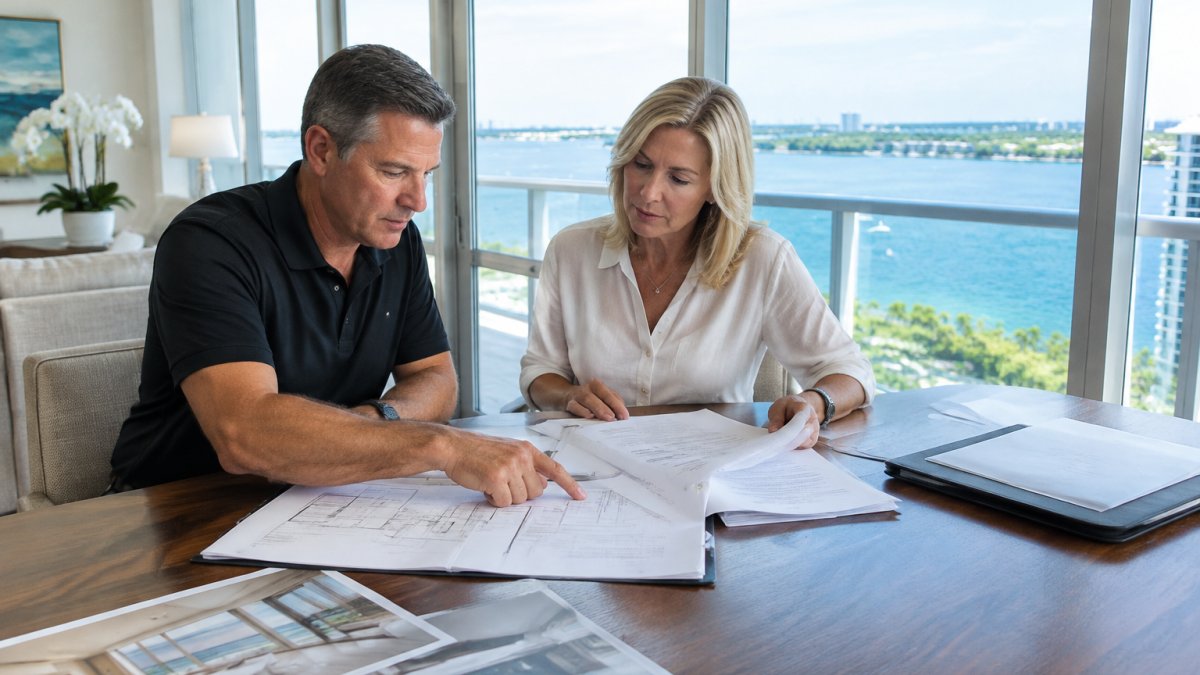
Your condominium association usually controls far more than the paint color. Boards commonly regulate work hours, elevator reservations, contractor parking, debris removal, water shutoffs, and which trades may work after hours.
The Enclave of Naples contractor guidance is a useful example: it states that the board must approve a remodeling or renovation project before work begins (Enclave of Naples contractor guidance). For a deeper walkthrough of association coordination, see managing condo renovation in Southwest Florida.
Documents to Collect Before You Call Anyone
Gather these before your first contractor call, because every serious bidder will ask for them:
- Current declaration and bylaws, plus any renovation addendum
- The board's renovation application and approval timeline
- Certificate of insurance requirements for vendors
Owners who have this packet ready move through approvals noticeably faster, and contractors can price the job against real constraints instead of guessing.
How to Run a Florida Contractor License Lookup
A Florida contractor license lookup is a state database search that can confirm whether a contractor holds an active, valid license for the work you're hiring.
Start at the state licensing database and search by the company name and by the individual's name. Cross-check the license type against your project scope: a general contractor, a roofing specialist, and a plumbing contractor hold different licenses.
What the License Record Tells You
The record shows license status, license type, expiration date, and any disciplinary history. An active status matters, but so does the license category. A license that doesn't cover high-rise interior renovation is a red flag regardless of how good the bid looks.
A lapsed or "null and void" status should be questioned before you proceed. Ask for documentation of current licensing before accepting any bid.
Insurance and Contract Checks That Protect a Naples High-Rise Condo Owner
Insurance verification matters on every bid. Ask for a certificate of insurance naming you and, where required, the association as additional insured, and confirm the policy is current by calling the agent directly.
High-rise work carries risks a single-family job doesn't: water damage that reaches units below, elevator and common-area exposure, and debris handling. Ask specifically about general liability limits, workers' compensation, and whether the policy covers interior renovation in multi-unit buildings.
Coverage Limits That Fit High-Rise Work
Match coverage to the worst realistic outcome, not the average one. A water leak on an upper floor can affect several units and common areas at once. If a contractor's liability limit looks thin for that scenario, that's your answer.
Questions to Ask a Remodeling Contractor Before You Sign
The right questions separate operators from professionals. Ask each bidder the same list and compare answers side by side:
- Who is the qualifying licensee, and will they be on site?
- How do you handle association approvals and inspection scheduling?
- What is your change-order process, in writing?
A common mistake is asking these verbally and never writing the answers into the contract. Get them in writing.
A Condo Remodeling Contract Checklist for High-Rise Units
Use this condo remodeling contract checklist before signing anything:
- Scope of work with room-by-room detail and named materials
- Fixed price or clearly defined cost-plus structure
- Payment schedule tied to completed milestones, not calendar dates
If a contract is missing three or more of these, don't sign it.
Building a Realistic Condo Remodeling Project Timeline
A realistic condo remodeling project timeline for a high-rise unit runs longer than a house renovation of the same size, because approvals and building logistics add stages a house never sees. Plan for design, board approval, permitting, construction, and inspection as separate phases, and treat the approval phase as the one most likely to set the start date.
The Approval Sequence, Step by Step
Most associations follow a version of this order. Confirm your building's exact process with the board before you assume any step.
- Read the renovation rules. Get the declaration, bylaws, and any renovation addendum, plus the board's application form and fee schedule.
- Confirm insurance and licensing requirements. Many boards require a certificate of insurance naming the association as additional insured and proof of an active state license before they will review a plan.
- Submit plans and specifications. Architectural review often requires drawings, a scope narrative, and product selections. Incomplete submissions are the most common cause of delay.
- Wait for the review cycle. Boards and architectural review committees frequently meet monthly, so a submission that misses the agenda waits a full cycle.
- Receive written approval. Do not schedule work on a verbal okay. Get the approval in writing, with any conditions attached.
- Pull permits. Permit responsibility should be stated explicitly in the contract; confirm who files and who pays.
- Reserve building resources. Book elevator time, loading access, and any required work windows before construction starts.
High-Rise Logistics That Set the Schedule
Construction time in a high-rise is shaped by building rules as much as by the trades. Build these into the schedule:
- Work hours. Many associations restrict noisy work to weekday daytime windows and prohibit weekend work. A crew that can only work six hours a day takes longer than one working a full day.
- Elevator reservations. Reserved elevator time is often booked weeks out and limited to specific hours. Material deliveries and debris removal depend on it.
- Delivery and loading access. Loading dock windows, freight elevator rules, and parking restrictions affect how materials reach the unit.
- Debris removal. Corridor protection, debris bags, and scheduled haul-away are required in most buildings and add time between phases.
Where High-Rise Schedules Slip
Schedules slip in predictable places: board meeting calendars that meet monthly, elevator reservations booked weeks out, inspection windows that push trades, and material lead times quoted before approval. If schedule protection matters to you, understand how penalty clauses for construction delays work before you sign.
Confirm board approval in writing before starting demolition, and keep a copy on site.
Most associations follow a version of this approval order, so confirm your building's exact process with the board before assuming any step.
| Step | What to do |
|---|---|
| 1 | Read the renovation rules, declaration, bylaws, and application form |
| 2 | Confirm insurance and licensing requirements |
| 3 | Submit plans and specifications for architectural review |
| 4 | Wait for the review cycle, often monthly |
| 5 | Receive written approval with any conditions attached |
| 6 | Pull permits, confirming who files and pays |
| 7 | Reserve elevator time, loading access, and work windows |
Comparing Bids and Locking In a Fixed Price
Two bids for the same high-rise unit can differ noticeably, and the gap is often in what each bid includes or excludes. Comparing bottom-line totals is the fastest way to pick the wrong contractor. Build a bid-leveling matrix instead, and make every bidder fill in the same rows.
The Bid-Leveling Matrix
Set up a simple spreadsheet with one column per bidder and these rows:
- Demolition and debris hauling (included or excluded?)
- Protection of common areas, elevators, and corridors
- Permits and association application fees
- Design and 3D renderings
A bid that looks low often has three or four of these rows marked "excluded" or left blank. That is not a cheaper bid; it is an incomplete one. Ask each contractor to fill every row in writing before you compare totals.
Allowances: The Hidden Variable
Many bids carry allowances for finishes rather than fixed prices. An allowance is a placeholder budget the owner controls, and if the actual selection runs over, the owner pays the difference. Two bids with the same total can behave very differently if one carries a realistic allowance for cabinetry and the other carries a number no showroom can meet.
What Drives Cost in a High-Rise Unit
Budget drivers in a high-rise condo differ from a single-family renovation. Expect these to move the number:
- Building fees and deposits. Many associations charge a move-in or renovation deposit or require elevator protection. Ask the board for the current fee schedule.
- Elevator and loading access. Reserved elevator time and after-hours deliveries add labor and scheduling cost.
- Protection and cleanup. Corridor protection, negative air machines for dust, and daily debris removal are line items a house job never sees.
- Water shutoffs and plumbing access. Coordinating shutoffs with building staff and neighboring units adds supervision time.
Fixed Price vs. Cost-Plus, Decided on Scope
A fixed-price contract locks the number for a defined scope, which is why it fits most condo projects where the scope can be drawn precisely. If you are weighing the two, read our comparison of fixed price vs cost plus remodeling before committing.
Watch out: a bid that is dramatically lower than the others usually means an excluded scope item or an unrealistic allowance, not a better deal. Ask the low bidder to itemize what they left out before you eliminate the others.
Request a Free Quote From Accent Construction & Remodeling
The hardest part of hiring a contractor for a Naples high-rise condo isn't finding names. That's the work we do daily: condo and high-rise remodeling with direct HOA and fire inspector coordination, fixed-price contracts for most projects under $1.5 million, owner-led management from founder John Pelland, and 3D design planning so you see the result before work starts.
We're licensed and insured (CGC1519502) and were established in 2005.
Ready to move from bid confusion to a clear scope and a fixed price? Get started with Accent Construction & Remodeling and request a free, no-obligation consultation about your project.
Frequently Asked Questions
What insurance should a contractor have for work in a high-rise condo?
Ask for a certificate of general liability insurance and proof of workers' compensation coverage, and confirm the limits are high enough for a high-rise unit. Call the insurer to verify the policy is active and that the named insured matches the contracting entity. Also ask whether the policy covers water damage and interior work in occupied buildings, because a leak on an upper floor can affect several units below.
How do I check whether a contractor is licensed in Florida?
Use the state license lookup run by the Florida Department of Business and Professional Regulation. Search by the company name or the license number the contractor gives you. Confirm the license is current, the status is active, and the qualifying individual is named. The contractor's license number should appear on the contract and estimate. If the record shows an expired status or a different company name, ask why before going further.
What approvals are needed before remodeling a high-rise condo?
Most associations require board approval before work begins. Most associations require board approval before a renovation project starts. Expect to submit plans, contractor insurance certificates, and a scope of work, and to follow rules on work hours, elevator use, and debris removal. Confirm the specific requirements with your condo association, since each building sets its own process and review time.
How should a condo renovation contract describe the scope, schedule, and payment terms?
The contract should list every room and item in scope, name the brands or allowance amounts for finishes, and state the start and completion dates. Payment should follow completed milestones rather than a large deposit, and the contract should explain how change orders are priced and approved in writing. Include the association approval as a condition, name who handles permit coordination, and set out what happens if the building delays access.