 How-to
Managing a Home Renovation While Living Out of State
Last Updated: November 26, 2026
Quick Summary
You manage a home renovation while living out of state by hiring a vetted local contractor, locking in a contract with a written payment schedule, setting up scheduled photo and video updates, and keeping a contingency fund for surprises. Remote oversight works when the process is documented, not when you rely on trust alone.
- Choose a licensed local general contractor who manages the trades directly rather than acting as a broker.
- Tie each payment draw to a completed milestone you can verify in photos, and hold back retainage until the punch list is done.
- Require a conditional lien waiver with every draw to avoid exposure to subcontractor liens.
- Set a fixed rhythm of weekly dated photos, biweekly video walkthroughs, and one virtual meeting per week.
- Confirm the contractor pulls permits in their own name and get the permit number in writing before work starts.
Table of Contents
- How Do You Manage a Home Renovation While Living Out of State?
- How to Choose a Remodeling Contractor for a Long-Distance Project
- Building a Realistic Home Renovation Project Timeline
- Setting Up Remote Construction Progress Updates
- Contracts, Payment Schedules, and Change Orders From a Distance
- Permits, Inspections, and Local Code Compliance
- Planning a Renovation Budget Contingency and Tracking Costs Remotely
- Getting a Fixed-Price Quote for Your Out-of-State Renovation
- Frequently Asked Questions
How Do You Manage a Home Renovation While Living Out of State?
You manage a home renovation while living out of state by hiring a vetted local contractor, locking in a contract with a written payment schedule, setting up scheduled photo and video updates, and keeping a contingency fund for surprises.
The stakes are higher than most owners expect. According to Redfin's 2026 survey on remodeling versus relocating, 71% of homeowners planning to renovate in the next year said they were remodeling instead of buying a new home.
Below, we'll show you exactly how to build those controls, from contractor vetting to the final punch list.
How to Choose a Remodeling Contractor for a Long-Distance Project
A remodeling contractor for a long-distance project is a licensed local general contractor who can prove they communicate well in writing and on camera. Choose one who directly manages the trades rather than acting as a broker who subcontracts everything. A contractor who keeps decisions, schedules, and trade coordination visible in regular updates can help you manage renovation project stress from a distance.
Here's how to choose a remodeling contractor when you can't drop by the job site:
- Confirm the license. Look up the license number on your state's contractor licensing database. Ask for the number in writing.
- Verify insurance. Request a certificate of general liability and workers' compensation coverage.
- Check the local footprint. A contractor with years of work in the area is familiar with local inspectors and suppliers.
Vetting Credentials, Licenses, and Insurance
Ask for documents before any interview, including the state license number and a certificate of insurance. Call the insurer to confirm the policy is active. A contractor who hesitates on any of these is a contractor you skip.
Interview Questions That Reveal How a Contractor Communicates
The interview tells you more than the brochure. Ask:
- How often will I get updates, and in what format?
- Who is my single point of contact?
- How do you handle a problem you find behind the drywall?
- Can you send me a sample weekly report from a past job?
A contractor who answers with specifics, not generalities, is one who has done remote work before.
Building a Realistic Home Renovation Project Timeline
A home renovation project timeline for a remote owner should build in extra time for approvals, material lead times, and inspection scheduling. Most delays come from decisions, not labor.
Plan your schedule in phases:
- Weeks 1-3: Design, permits, and material selections.
- Weeks 4-6: Demolition and rough-in.
- Weeks 7-12: Finishes and fixtures.
The Harvard Joint Center for Housing Studies projected 2.1% year-over-year growth in renovation and repair spending in mid-2026 before easing, per its Leading Indicator of Remodeling Activity. Busier markets mean busier inspectors and suppliers, so pad the schedule.
Setting Up Remote Construction Progress Updates
Remote construction progress updates work best on a fixed rhythm: a weekly photo set, a biweekly video walkthrough, and a standing virtual meeting. Consistency beats volume.
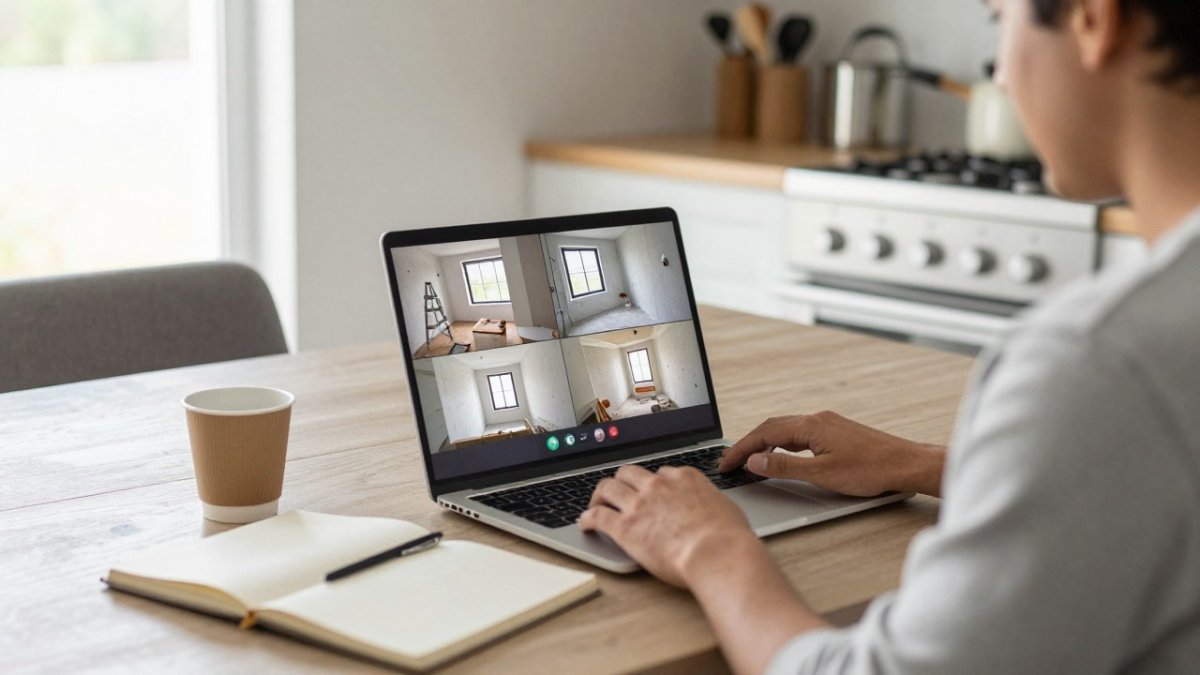
Photos, Video Walkthroughs, and Virtual Meetings
Set the expectations in writing before work starts:
- Weekly dated photos from the same angles
- Biweekly video walkthrough with narration
- One scheduled virtual meeting per week
Ask for photos of the same corners each week. That's how you catch a shifted wall or a wrong tile before it's finished.
Contracts, Payment Schedules, and Change Orders From a Distance
A remote renovation contract must spell out the scope, the payment schedule, and the exact process for change orders. Never pay a large lump sum upfront. Tie each payment to a completed milestone you can verify in photos. The contract is a key source of leverage when you are far away, so treat it as an operating manual rather than a formality.
Build a Milestone-Based Payment Schedule
Structure payments around verifiable completion, not calendar dates. A common pattern is a modest deposit to secure materials and scheduling, followed by draws released only after you confirm the prior milestone in writing and in photos. A workable sequence looks like this:
- Deposit: contract signing and material ordering.
- Draw 1: demolition complete and rough-in inspected.
- Draw 2: drywall, electrical, and plumbing rough-in signed off.
Hold back a retainage until the punch list is complete and you have the final inspection sign-off. Retainage is your incentive for the contractor to return and finish small items after the crew has moved on.
Require Lien Waivers With Every Draw
When you pay a draw, request a conditional lien waiver from the general contractor and, where the contractor uses subcontractors, from the major subs as well. A lien waiver confirms that the party signing it has been paid for the work covered by that draw and gives up the right to file a mechanic's lien for that amount.
Watch out: paying a draw before receiving the corresponding lien waiver can leave you exposed to a subcontractor lien even after you have paid the general contractor in full.
Run Change Orders Through a Written Approval Loop
Scope changes are where remote projects bleed money. Establish a rule before work starts: no change proceeds without a written change order that states the added scope, the added cost, and the schedule impact, and no change order is valid until you approve it in writing (email is fine, but a signed PDF is better). Require the contractor to submit a change order for any deviation above a threshold you set, even a few hundred dollars, so small extras do not quietly accumulate.
A practical remote approval loop:
- Contractor submits a written change order with cost and time impact.
- You review it against the original scope and the budget tracker.
- You approve or reject in writing within a set window (for example, two business days).
- The approved change order is logged in the shared folder and reflected in the next draw.
Keep the Paper Trail Centralized
Store the signed contract, every change order, every invoice, every lien waiver, and every inspection sign-off in one shared folder the contractor can also access. Before you sign, walk through how to review construction contract terms step by step. And if you're worried about mid-project surprises, read our guide on how to avoid construction change orders before the first draw.
Permits, Inspections, and Local Code Compliance
Permits and inspections are the contractor's job, but the owner carries the risk if they are skipped. Ask for the permit number and the inspection schedule in writing. Confirm the contractor pulls permits in their own name, because a permit issued to the homeowner can leave you holding the liability if something goes wrong. When you cannot walk into the building department yourself, your job is to verify the paper trail at every stage.
Confirm Who Pulls the Permit, and Get the Number
Before work starts, ask the contractor to send you the permit application and, once issued, the permit number and the posted permit card. Most jurisdictions post permit status in an online portal, so you can look up the number yourself and confirm the scope, the contractor of record, and the inspection history. If the contractor cannot or will not provide a permit number for work that clearly requires one, treat that as a stop signal.
Track Inspections With a Simple Log
Inspections happen on the jurisdiction's schedule, not yours, so build a log you update after every update call. A workable format:
| Stage | Who Handles It | What You Verify Remotely |
|---|---|---|
| Permit application | Contractor | Permit number and posted card in writing |
| Rough-in inspection (framing, electrical, plumbing) | Contractor + inspector | Signed inspection card or portal status |
| Insulation and drywall inspection | Contractor + inspector | Signed card before drywall closes |
| Final inspection | Contractor + inspector | Certificate of occupancy or final sign-off |
Ask the contractor to photograph the signed inspection card or screenshot the portal result and send it to you the same day. That photo is your proof that the inspection actually happened and passed.
Watch out: a contractor who schedules the next phase before the prior inspection passes creates rework risk, require written confirmation of a passed inspection before drywall, tile, or finishes cover the work.
Verify Code Compliance Without Being There
You do not need to read the code book, but you do need to confirm that the work matches what the inspector approved. Ask for the approved plan set and compare it to the photos you receive. If the contractor proposes a field change that affects structure, electrical, or plumbing, require a revised permit or an inspector's approval before the change is built in.
Keep the Compliance File With the Project File
Store the permit, every inspection card photo, the approved plans, and the final certificate of occupancy in the same shared folder as your contract and invoices. If you ever sell the property, that file is the record that the work was permitted and inspected. If a contractor suggests skipping a permit to save time, that is your signal to walk away.
Planning a Renovation Budget Contingency and Tracking Costs Remotely
A renovation budget contingency should be set aside as a percentage of the total project cost before work starts. Track every draw against the schedule and compare invoices to the scope. A fixed-price contract can limit overruns, but only if the scope is complete.
Track costs with a simple shared spreadsheet:
- Budgeted amount per line item
- Invoiced amount to date
- Remaining balance
Review it weekly alongside the photos. Owners who track remotely catch cost drift early, when it's still fixable.
Getting a Fixed-Price Quote for Your Out-of-State Renovation
A fixed-price quote sets your cost before work starts, which can limit exposure to material and labor changes. Ask for an itemized estimate that separates labor, materials, and allowances.
At Accent Construction & Remodeling, we offer fixed-price contracts for most projects under $1.5 million, backed by owner-led management from founder John Pelland and over 35 years of trade experience. Our fixed-price luxury renovation guide explains exactly what these contracts cover. When you're ready, request a free consultation and we'll walk you through the process.
Managing a renovation from another state is a test of process, not distance. The owners who sleep well are the ones who locked in a fixed price, set a weekly update rhythm, and kept every approval in writing.
Frequently Asked Questions
How do you manage a home renovation from out of state?
Start by hiring a licensed local contractor with a documented communication process, then agree on a detailed scope of work, itemized bid, and payment schedule before work begins. Set a standing weekly call, require photo and video progress updates, and keep a renovation budget contingency. A local project manager or property manager can handle site visits, deliveries, and punch list walkthroughs when you cannot be there in person.
How often should you visit a home renovation project?
Plan on at least one visit at the start to walk the scope with your contractor and one at the end for the final walkthrough and completion sign-off. For larger projects, add a mid-point visit around major milestones like rough-in inspections or cabinet delivery. Between visits, rely on remote construction progress updates, including dated photos and video walkthroughs, so you can catch issues before they get covered up.
How do you handle change orders when you cannot visit the job site?
Require every change order in writing with a fixed price, a description of the work, and a revised completion date before any work proceeds. Approve changes by email or through a shared document so there is a clear record. A well-built contract with a detailed scope of work limits how many change orders come up, and a renovation budget contingency covers the ones that are genuinely unexpected, such as hidden water damage behind a wall.
What should you include in a renovation contract when you live out of state?
Include the full scope of work, itemized estimate, payment schedule tied to completed milestones, change order process, permit responsibility, inspection schedule, and a completion date with consequences for missed deadlines. Add language covering property access, lockbox use, and who supervises subcontractors. Confirm the contractor's license number and insurance certificate, and keep all signed documents in a shared cloud folder so both parties work from the same version.