 Listicle
Which Residential Construction Companies Are Worth Hiring?
Last Updated: November 19, 2026
Quick Summary
Residential construction companies are worth hiring when you compare them on contract type, licensing, references, timeline penalties, and scope detail. Verify the license and insurance yourself, call past clients, and insist on a fixed-price contract with written allowances and contingency. A low bid with thin allowances is not a low price.
- Ask every builder for the allowance schedule in writing and compare it line by line.
- Custom build contingency commonly runs 5% to 10% of hard costs.
- Confirm the permit applicant matches the license holder before signing.
- Collect a conditional lien waiver for each payment from the builder and major subcontractors.
- Fixed-price contracts cover most Accent projects under $1.5 million.
Table of Contents
- Residential Construction Companies: How to Compare Them
- Questions to Ask a Home Builder Before You Sign
- Custom Home Construction Cost: What Drives the Number
- Why a Fixed-Price Construction Contract Changes Everything
- Home Builder Reviews and References: What to Verify
- Licensing, Insurance, and Permits: The Checks That Protect You
- Residential Construction Companies in Southwest Florida: Top Picks
- 1. Accent Construction & Remodeling, Best for Fixed-Price Luxury Builds
- 2. Big-D Signature, Best for Large Private Estates
- 3. Murphy's Custom Homes, Best for Hands-On Communication
- 4. Ash Creek Homes, Best for Community Settings
- 5. Perry Homes, Best for Master-Planned Communities
- 6. TXR AC, Best for Architect-Led Waterfront Design
- Getting Your Free Quote from Accent Construction & Remodeling
- Frequently Asked Questions
Residential Construction Companies: How to Compare Them
The U.S. Census Bureau reports 1,295,000 building permits and 1,309,000 housing starts in its October 2026 new residential construction release, yet the same release shows activity 7.4% below the prior month. That gap matters when you're choosing among residential construction companies: a softer market does not make a bad contract cheaper. Homeowners who sign on price alone often end up paying for it in change orders. Below, we break down how to compare builders, what to ask, and what actually drives cost.
A residential construction company is a licensed business that manages the building, renovation, or structural alteration of homes, from permits and scheduling to subcontractor oversight and final inspection. The category covers custom home builders, general contractors, and remodeling firms, and those are not interchangeable.
Compare builders on five things: contract type, licensing, references, timeline penalties, and scope detail.
| Comparison Point | What to Check | Red Flag |
|---|---|---|
| Contract type | Fixed-price or cost-plus in writing | Verbal estimates only |
| License | State registration number | No verifiable number |
| References | Past clients you can call | Names without contacts |
| Timeline | Delay penalties written in | "We always finish on time" |
| Scope | Line-item allowances | One lump-sum figure |
Questions to Ask a Home Builder Before You Sign
Ask about change-order procedures, delay penalties, payment schedules, and who supervises the site daily. The answers reveal more than the pitch does. A builder who hesitates on any of these is telling you something.
Bring this list to every meeting:
- Who is the licensed qualifier on my permit, and what is the license number?
- Is this a fixed-price contract, and what specifically triggers a change order?
- What happens financially if you miss the completion date?
- Which allowances are included, and what happens if I exceed them?
- Can I speak with two clients from the past 18 months?
- Who is on site daily, and how do I reach that person?
- How do you handle inspections and permit closeout?
On delays specifically, penalty clauses are worth understanding before you negotiate. Watch out: a contract with no completion date and no penalty language gives the builder every incentive to move your job behind a more profitable one.
Custom Home Construction Cost: What Drives the Number
Custom home cost is driven by site conditions, square footage, finish level, and structural complexity, not by a single per-square-foot rate. Builders who quote one number before seeing your lot are guessing.
Material prices remain under pressure. Buildertrend's 2026 construction statistics reports residential building material prices growing above 3% annually since June 2025, even as housing demand softened.
A custom home budget is really six buckets. The split below shows the general categories involved in a custom home budget:
| Budget bucket | What it covers | What moves it |
|---|---|---|
| Land and site work | Lot cost, clearing, grading, fill, drainage, utilities to the house | Waterfront lots, flood zones, steep grades, well and septic |
| Structure and shell | Foundation, framing, roofing, windows, exterior | Spans, second stories, wind-load and energy-code requirements |
| Mechanical, electrical, plumbing | HVAC, wiring, fixtures, water and waste lines | System complexity, smart-home wiring, generator and solar prep |
| Finishes | Cabinetry, countertops, flooring, tile, millwork, paint | Selection level, the single largest swing in most budgets |
| Fixed site costs | Permits, inspections, impact fees, insurance during construction | Jurisdiction and project value |
| Contingency | Reserve for unknowns and owner changes | Site conditions and how finalized the design is at signing |
Two mechanisms decide whether your final number lands near the contract number. The first is allowances: a line-item dollar figure the builder budgets for a selection you haven't made yet, such as $X for cabinetry. If you choose above the allowance, you pay the difference as a change order.
Site work is where estimates most often break. A flat, serviced lot and a waterfront lot with fill, retaining, and drainage can differ by a wide margin before a single wall goes up.
Pricing depends on scope, site, and selections. Visit our custom home page for current information on what the build includes. When you compare builders, ask each one to break the estimate into the six buckets above and to state the allowance schedule and contingency separately, that is the only apples-to-apples comparison.
Why a Fixed-Price Construction Contract Changes Everything
A fixed-price contract locks the agreed scope at a set number, so cost overruns from labor or material pricing land on the builder, not you. Cost-plus passes those overruns through. That single difference decides how much risk you carry.
Many homeowners have been burned by a low bid that grew through change orders. A fixed price removes that incentive. It also forces the builder to price carefully up front, which means the scope has to be genuinely detailed before signing.
One honest caveat: fixed-price works when the scope is defined. If you're still undecided on layout or finishes, no builder can lock a number honestly. That's why we plan in 3D before pricing.
If you're weighing the two structures in detail, our fixed-price versus cost-plus comparison walks through both.
Home Builder Reviews and References: What to Verify
Verify references by calling past clients directly and asking about change orders, communication, and whether the builder finished on schedule. Online ratings help you build a shortlist, but they don't replace a phone call.
What to ask each reference:
- Did the final price match the contract?
- Were change orders explained before work started?
- How quickly did the builder respond mid-project?
- Would you hire them again?
A Cal Poly case study on small construction firms found that capacity and competitiveness vary widely among smaller builders, which is exactly why references from comparable projects matter more than star averages. Ask for clients whose project resembled yours in size and complexity.
Photos help too. Our project gallery shows completed custom homes and renovations, which is a useful starting point for questions.
Licensing, Insurance, and Permits: The Checks That Protect You
Confirm three things before signing: an active state contractor license, current general liability and workers' compensation coverage, and permits pulled in the licensed contractor's name. Each one protects you from a different failure, and each one is verifiable without trusting the builder's word.
License. Ask for the license number and the name of the licensed qualifier, the individual who holds the license for the company. Verify both with the state licensing board's online lookup yourself. Check that the license is active, that the classification matches residential work, and that no disciplinary actions are posted.
Insurance. Request a certificate of insurance sent directly from the insurer or agent, not a photocopy from the builder. Confirm two coverages: general liability, which responds to property damage and third-party injury, and workers' compensation, which covers injuries to workers on your site.
Permits. Confirm the permit applicant matches the license holder.
Beyond the three checks, read the contract for the terms that decide disputes:
- Payment schedule: progress payments tied to completed milestones, not to a calendar. A large deposit before work starts is a warning sign.
- Lien waivers: for each payment, collect a conditional lien waiver from the builder and major subcontractors so suppliers can't lien your home for unpaid bills.
- Change-order procedure: written, priced, and signed before the work happens, never after.
- Dispute and warranty terms: what the builder warrants, for how long, and how defects are resolved.
- Cancellation rights: confirm any statutory right to cancel and the deadline in your state.
A practical pattern is to keep a single folder with the license lookup printout, the insurance certificate, the permit record, and every signed change order. If a dispute ever arises, that folder is your evidence. None of these checks requires technical knowledge, they require asking for documents and verifying them at the source.
Residential Construction Companies in Southwest Florida: Top Picks
Here's our assessment of builders worth considering for custom and luxury residential work. We've ranked them by fit for complex, high-value projects, and we've noted honestly where each one suits a different buyer.
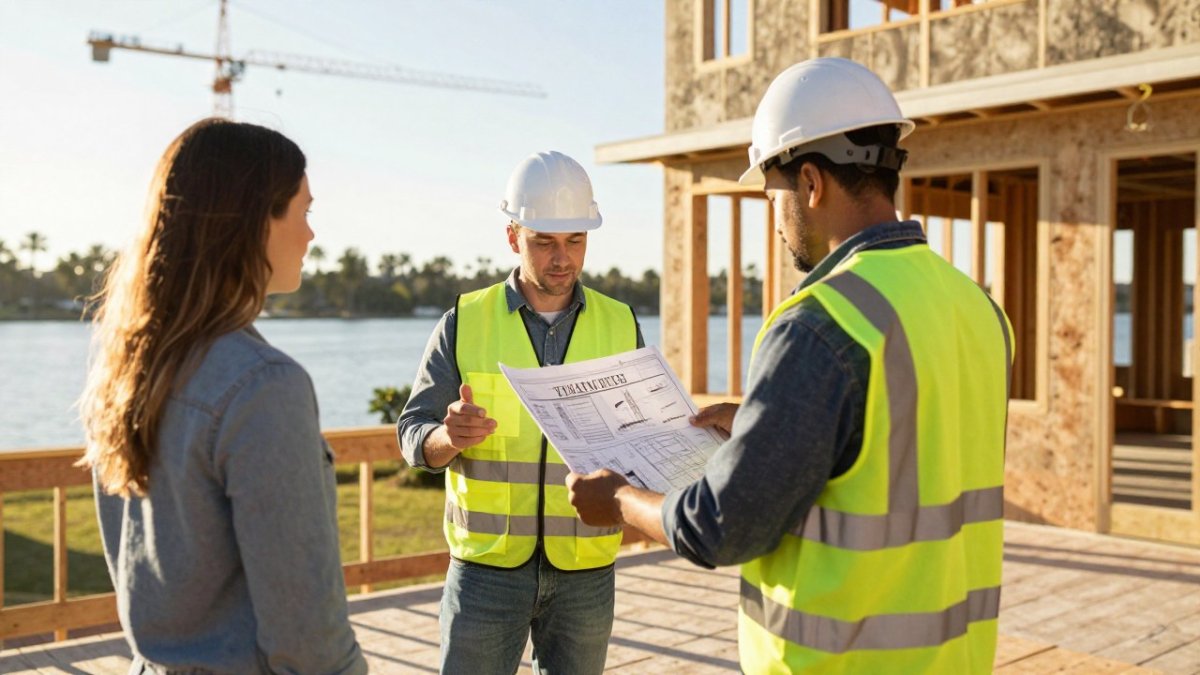
1. Accent Construction & Remodeling, Best for Fixed-Price Luxury Builds
Our own firm. Founder John Pelland brings 35+ years of trade experience and leads owner-led project management. Fixed-price contracts cover most projects under $1.5 million, and our on-time completion guarantee carries self-imposed penalties.
Best for: waterfront custom homes and luxury renovations where budget certainty matters. Skip if: you want the lowest bid and don't care about contract structure.
2. Big-D Signature, Best for Large Private Estates
Best for: high-net-worth buyers building estate-scale properties. Skip if: your project is a renovation rather than a ground-up build.
3. Murphy's Custom Homes, Best for Hands-On Communication
Best for: owners who want frequent contact with the builder. Skip if: you need a large team running multiple complex trades at once.
4. Ash Creek Homes, Best for Community Settings
Best for: semi-custom homes in planned communities. Skip if: you're building on an unusual waterfront lot.
5. Perry Homes, Best for Master-Planned Communities
Best for: buyers who want a new home without a fully custom design process. Skip if: your plans are one-of-a-kind.
6. TXR AC, Best for Architect-Led Waterfront Design
Best for: clients wanting one team for design and construction. Skip if: you already have completed architectural drawings.
Getting Your Free Quote from Accent Construction & Remodeling
The hardest part of hiring a residential construction company isn't finding candidates. It's getting a straight number and a straight timeline before you commit.
Fixed-price contracts lock your budget on most projects under $1.5 million. Owner-led management means John Pelland is on your job, not just on the letterhead. Our on-time completion guarantee carries self-imposed penalties. If your project is in Southwest Florida and the scope is serious, start the conversation and we'll walk the property with you.
Get a free, no-obligation consultation and a scope-based estimate before you sign anything.
Frequently Asked Questions
How do you compare residential construction companies fairly?
Use the same checklist for every bidder. Compare license and insurance status, contract type, written scope, allowance amounts, timeline penalties, warranty terms, and verified reviews. Ask each company for three recent references on projects similar to yours and call them. A builder that answers every item in writing is a better bet than one that only talks well in the sales meeting.
Is $200,000 enough to build a house?
It depends on size, site, and finish level. At that budget, expect a modest footprint, standard finishes, and careful site selection. Waterfront lots, extensive custom millwork, and high-end kitchen and bathroom packages push costs well past that figure. Get a line-item estimate before you buy land so the lot cost and site work do not consume the build budget.
What should you avoid telling a contractor?
Avoid naming your maximum budget early or saying you are flexible on price. Do not approve verbal changes, and never pay a large deposit before a signed contract with a written scope. Keep change orders in writing with costs attached. Vagueness about your priorities invites allowances that get revised upward later.
How long does it take to build a custom home?
Most custom homes take 10 to 18 months from permit to final walkthrough, and waterfront or high-rise projects can run longer because of permitting and HOA review. Ask each builder for a written schedule with milestones and a stated consequence for missed dates. A completion guarantee with penalties is worth more than a verbal promise.
What questions should you ask a residential construction company?
Ask who runs the job site day to day, whether the contract is fixed-price or cost-plus, how change orders are priced, what the warranty covers and for how long, and how HOA or permit coordination is handled. Also ask for the license number, certificate of insurance, and three references you can call. Written answers separate serious builders from talkers.