 how-to
Hiring a General Contractor for Waterfront Property
Table of Contents
- What Makes Hiring a General Contractor for Waterfront Property Different
- Waterfront Construction Permits and Flood Zone Requirements
- How to Vet a Waterfront Home Renovation Contractor
- Questions to Ask a General Contractor Before You Hire
- General Contractor Red Flags on Waterfront Projects
- How to Compare Bids and Protect Your Waterfront Project
- Conclusion
- Frequently Asked Questions
Last Updated: October 12, 2026
What Makes Hiring a General Contractor for Waterfront Property Different
Hiring a waterfront contractor is not the same as hiring a general contractor for an inland home. Waterfront construction adds flood rules, salt air, weak soil, and shoreline structures to every decision.
Three things change on the water:
- Permits multiply. You may need local, state, and federal approvals before anyone digs.
- The ground is different. Coastal soil is often sandy or soft, so foundations may need deep support.
- Materials age faster. Saltwater exposure and humidity break down the wrong products quickly.
The good news: a waterfront contractor who knows these risks can plan for them from day one. Below, we break down exactly how to vet, question, and hire the right builder for your project.
Waterfront Construction Permits and Flood Zone Requirements
Waterfront construction permits are the first hurdle, and they trip up more projects than any other step. Most waterfront properties sit in a designated flood zone, which means your builder must meet specific elevation and building code rules before work starts. What separates a smooth project from a stalled one is understanding that waterfront permitting is not a single approval, it is a stack of them, and they run on different clocks.
The Four Layers of Approval
A typical waterfront project can require sign-off at four levels, and each one can hold up the next:
- Local building and zoning. Your county or municipality issues the building permit and enforces the flood damage prevention ordinance that adopts FEMA's minimum elevation standards. This is the permit most homeowners know about.
- State environmental and coastal management. Many states run a coastal management program that reviews construction near the shoreline, wetlands, or critical habitat. This review is separate from the building permit and often takes longer.
- Federal triggers. Work in navigable waters, wetlands, or tidally influenced areas can require a permit from the U.S. Army Corps of Engineers under Section 404 of the Clean Water Act, and in some cases a Section 10 permit for structures in navigable waters. The Corps reviews can take months.
- Shoreline structure permits. Seawalls, docks, bulkheads, and piers usually need their own approvals, often from a state agency or a local marine authority, on top of everything above.
Documents You Should Expect to Produce
- Flood zone determination. Your county maps the property to a flood zone (for example, an AE or VE zone), and that zone sets your minimum elevation. VE zones, which are subject to wave action, carry stricter requirements than AE zones.
- Elevation certificate. A licensed surveyor certifies the finished floor height after construction. Lenders and flood insurance carriers often require it.
- Site and erosion control plan. Most jurisdictions require a stormwater pollution prevention plan or equivalent before ground is disturbed.
FEMA flood zone and elevation guidance explains how flood zones affect construction. Your local building department adds its own zoning requirements on top.
How Environmental Triggers Change the Timeline
The single biggest schedule risk on the water is an environmental trigger the homeowner did not know existed. A wetland delineation, a protected species survey, or a shoreline vegetation buffer can turn a two-month permit into a six-month one. A contractor who has done this before will flag those triggers during the site visit, before you sign anything, and build the approval timeline into the contract.
What to Ask Before You Sign
- Which permits will you pull, and which are my responsibility?
- Have you worked with the state coastal program and the Corps before?
- What is your plan if an environmental review adds three months?
- Who pays for re-surveying if the elevation certificate comes back short?
A builder who can answer those four questions with specifics has done this before. One who cannot is learning on your dime.
How to Vet a Waterfront Home Renovation Contractor
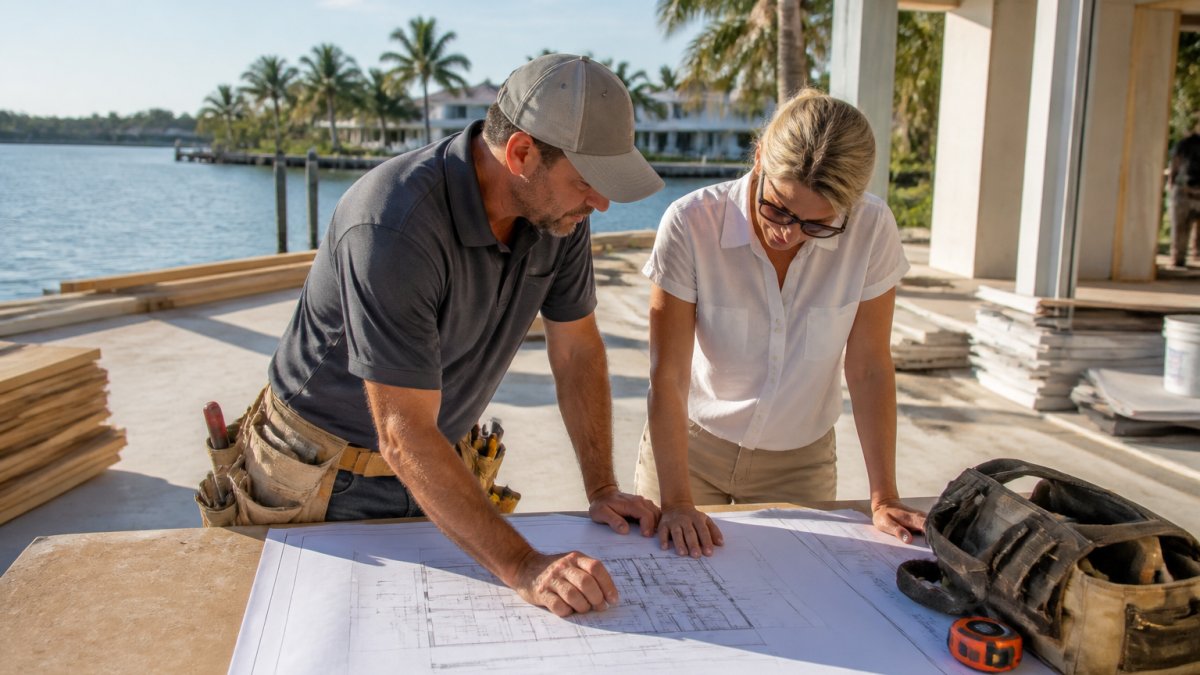
Vetting a waterfront home renovation contractor comes down to proof, not promises. Ask for documents, then check them yourself. A builder with coastal experience will hand them over without hesitation.
Verify Licensing, Insurance, and Coastal Experience
A licensed contractor holds a current state license, carries general liability and workers' comp insurance, and can show coastal projects in their portfolio. Ask for the license number and verify it with your state's licensing board. Request a certificate of insurance and call the insurer to confirm it is active.
Coastal experience matters because waterfront work involves helical piles, erosion control, and corrosion-resistant materials that inland builders rarely touch.
Check References from Past Waterfront Projects
References should come from owners of past waterfront projects, not just any job. Ask each reference:
- Did the builder handle permits and inspections?
- Were there surprise change orders?
- How did they handle weather delays?
- Would you hire them again?
Call at least three. One glowing reference is a story; three consistent ones are a pattern.
Questions to Ask a General Contractor Before You Hire
The questions to ask a general contractor should expose how they handle risk, money, and communication. Good builders answer directly. Weak ones get vague.
Ask these:
- Who pulls the permits? The builder should handle this, not you.
- Is this a fixed-price contract? Fixed pricing protects you from surprise costs.
- Who is my daily point of contact? You want a name, not a call center.
- How do you handle change orders? Every change should be written and priced first.
- What is your timeline, and what happens if you miss it? Ask about penalties.
- Will you coordinate with my HOA? High-rise and condo projects need this.
- Who are your subcontractors? You want licensed, vetted trades.
Accent Construction & Remodeling uses fixed-price contracts for most projects under $1.5 million, with owner-led management and an on-time completion guarantee backed by self-imposed penalties. That structure answers several of these questions before you ask.
General Contractor Red Flags on Waterfront Projects
General contractor red flags are easier to spot once you know the pattern. The biggest one is a low bid with no detail. A vague estimate usually means the contractor plans to make up the difference with change orders later.
Watch for these:
- No written scope of work. If it is not in writing, it is not in the contract.
- Large upfront cash demands. Legitimate builders use a payment schedule tied to milestones.
- No local references. A coastal builder should have coastal clients.
- Pressure to skip permits. This is a dealbreaker on the water.
How to Compare Bids and Protect Your Waterfront Project
Comparing bids means comparing complete proposals, not totals. Two bids can look similar and cover completely different work. On the water, the gap between a cheap bid and a complete one is usually the foundation, the shoreline work, and who owns the permitting risk.
Normalize the Bids Before You Compare Numbers
A bid is only comparable if the scope, allowances, and contingencies line up. Before you look at totals, do this:
- Line up scopes side by side. Put each proposal's scope of work into the same categories: demolition, foundation, framing, envelope, mechanical, shoreline structures, site work, and finishes. Anything one bid lists and another omits is a gap, not a savings.
- Identify allowances. An allowance is a placeholder number for a material or fixture the owner will pick later. A low allowance (for example, a $2,000 allowance for tile in a $40,000 bathroom) is a hidden cost increase waiting to happen. Ask each builder to justify every allowance against real product selections.
- Check the contingency line. A waterfront bid with zero contingency is either overpriced elsewhere or planning to hit you with change orders. A reasonable contingency is normal on coastal work because subsurface conditions are uncertain.
- Compare exclusions. Every bid should list what it does not include: permits, surveys, engineering, shoreline structures, landscaping, and utility connections are common exclusions. Exclusions are where cheap bids hide.
- Compare payment schedules. A schedule tied to milestones protects you. A schedule front-loaded with a large deposit protects the builder.
| What to Compare | Why It Matters | Red Flag |
|---|---|---|
| Scope of work | Shows exactly what is included | Vague or missing details |
| Allowances | Placeholder numbers become real costs | Low allowances with no product list |
| Contingency | Covers unknown subsurface conditions | Zero contingency on coastal work |
| Exclusions | Reveals what you will pay separately | Permits, surveys, or shoreline work excluded |
| Permit handling | Confirms who files and pays | "Owner to pull permits" |
| Foundation method | Piles vs. standard footings | No soil plan mentioned |
| Materials | Corrosion-resistant vs. standard | No material specs listed |
| Payment schedule | Tied to milestones | Large upfront cash |
| Timeline | Start and finish dates | No dates given |
| Change order process | Written and priced first | Verbal changes only |
| Warranty | Covers workmanship | No warranty offered |
The lowest number is not the best bid. A complete bid with clear exclusions beats a cheap one with gaps every time.
Waterfront-Specific Contract Protections
Your contract should name the waterfront risks directly. Add these protections:
- Subsurface conditions clause. Coastal soil is unpredictable. The contract should state who pays if the foundation design changes after the soil report, the owner, the builder, or a shared contingency.
- Permitting-delay responsibility. Name who is responsible for delays caused by the building department, the state coastal program, or the Corps, and whether the completion date moves with the delay.
- Shoreline damage liability. If construction damages a seawall, bulkhead, or dock, or causes erosion on a neighbor's property, the contract should say who carries the risk and who repairs it.
- Weather and water-level clause. Define what counts as a weather delay (named storms, flood-stage water levels, wind thresholds) and how time is added to the schedule.
Get everything in writing. A handshake on the water is not a plan.
Conclusion
Waterfront construction rewards homeowners who do their homework. The permits are stricter, the soil is softer, and the salt air is unforgiving, so the contractor you choose matters more than the price you pay. Accent Construction & Remodeling brings 35+ years of trade experience, fixed-price contracts for most projects under $1.5 million, owner-led management from founder John Pelland, and an on-time completion guarantee with self-imposed penalties.
Frequently Asked Questions
Is hiring a general contractor worth it for a waterfront property?
Yes, for most waterfront projects it is worth it. Waterfront construction involves flood zone rules, elevation certificates, shoreline structures, and corrosion-resistant material choices that go beyond standard building. A licensed waterfront contractor coordinates permits, subcontractors, and inspections, which reduces the risk of costly rework. If your project touches a seawall, dock, or foundation near tidal water, the specialized knowledge alone justifies the cost.
What are red flags when hiring a contractor for waterfront work?
Watch for contractors who cannot show a state license and insurance certificate, who ask for large upfront payments before work begins, or who give vague verbal estimates instead of a written scope of work. Other general contractor red flags include no local waterfront references, reluctance to pull permits, and pressure to sign quickly. Any contractor who avoids discussing flood zone requirements or elevation should be disqualified immediately.
What should a waterfront construction contract include?
Your contract should spell out the full scope of work, a fixed price or clear cost breakdown, the project timeline with milestone dates, and how change orders are handled. For waterfront projects, add clauses covering shoreline structure repairs, corrosion-resistant materials, flood zone compliance, and who secures permits. Include a warranty on workmanship, a payment schedule tied to completed milestones, and a written process for resolving disputes.
How do I compare bids for a waterfront home project?
Line up each bid against the same scope of work and check what is excluded. One contractor may omit permit fees, site inspection costs, or shoreline repairs, making the bid look lower. Compare the materials specified, the timeline, and the payment schedule side by side. Ask each contractor to explain any line item that differs significantly. The lowest bid is rarely the best value when waterfront-specific costs are missing.