 blog
blog
PBC Contractors Alternative for Luxury Homes
Table of Contents
- What to Compare When Choosing a PBC Contractors Alternative for Luxury Homes
- Questions to Ask a Home Builder Before You Sign
- Verify the License and Insurance Before You Talk Scope
- Ask About Lien Waivers and Payment Milestones
- Ask How the Builder Handles Risk Before It Becomes a Change Order
- Ask About Method: Design-Build vs. Traditional General Contracting
- Ask About Material Sourcing and Lead Times
- Ask About Sustainability and Provenance
- The Written-Answers Test
- How a Fixed-Price Construction Contract Protects Your Budget
- Understanding the Luxury Home Construction Timeline
- What Custom Home Builder Reviews Actually Tell You
- How Accent Construction & Remodeling Compares as a PBC Contractors Alternative
- Frequently Asked Questions
Last Updated: October 7, 2026
What to Compare When Choosing a PBC Contractors Alternative for Luxury Homes
Choosing a PBC Contractors alternative for luxury homes starts with comparing how each builder prices, manages, and documents your project. Most homeowners focus on the bid number, but the contract structure behind it determines whether your budget holds or drifts.
We are Accent Construction & Remodeling, a Southwest Florida builder led by founder John Pelland, and we have watched homeowners sign contracts that looked clean until the first change order arrived.
Pricing Models: Fixed-Price vs. Cost-Plus
A fixed-price contract locks the total cost before work begins, while a cost-plus contract bills you for actual expenses plus an agreed markup.
Cost-plus arrangements feel fair because you see every invoice, but they leave the final number open.
Fixed-price shifts that risk to the builder, who must estimate carefully and manage subcontractor costs tightly. It only works when the pre-construction work is done properly.
Owner Involvement and Project Management Style
Who runs your job site daily matters as much as the contract. Some builders hand your project to a junior superintendent after signing; others keep ownership directly involved.
Ask one blunt question: will the person who walked you through the estimate be on site during construction?
National Association of Home Builders member resources notes that clear client communication is one of the most common factors separating smooth projects from disputed ones.
Questions to Ask a Home Builder Before You Sign
The right questions to ask a home builder expose how a company handles money, timelines, and surprises. Ask them before you sign, and ask for written answers. What separates a real luxury builder from a polished sales operation is whether the answers are documented, verifiable, and specific to your project.
Verify the License and Insurance Before You Talk Scope
Any contractor doing residential construction in this state must hold a state-issued license, and you can confirm status, qualifier, and complaint history through the state licensing database.
Then ask for three documents:
- A current certificate of general liability insurance with your project address listed
- Proof of workers' compensation coverage, or a valid exemption
- A surety letter if the builder offers a completion guarantee
A common pattern is a builder who carries liability coverage but relies on uninsured subcontractors. If a framer is hurt on your lot and the sub carries no workers' comp, the exposure can reach you as the property owner.
Ask About Lien Waivers and Payment Milestones
On a multi-million-dollar build, money moves in draws. Ask how the builder structures those draws and whether each is tied to a completed milestone you can inspect.
Ask directly: will I receive lien waivers from every sub and supplier at each draw? A builder who has never been asked is either new to high-end work or has been lucky.
Ask How the Builder Handles Risk Before It Becomes a Change Order
Change orders are where budgets quietly die, and the best defense is a scope fully defined before signing. Ask what triggers a change order in the builder's own contract language, and ask for a sample. Look for written approval before any work proceeds, and whether the change order includes a revised schedule impact, not just a revised price.
Ask About Method: Design-Build vs. Traditional General Contracting
A question most homeowners never think to ask: will the builder hold the design contract, or will you hire an architect separately and hand the plans over? Under design-build, one entity owns both design and construction, which shortens the feedback loop and usually reduces change orders caused by drawings that cannot be built as drawn. Under traditional general contracting, you hire the architect, bid the plans to multiple builders, and manage the interface.
Ask About Material Sourcing and Lead Times
Luxury finishes are not off-the-shelf. Ask how the builder sources stone, cabinetry, and specialty fixtures, and for realistic lead times on your specific products. A builder who quotes a schedule without confirming lead times on your selections is quoting a schedule for a different house.
Ask About Sustainability and Provenance
High-end clients increasingly ask where materials come from and how they were produced. Ask whether the builder can source certified wood, low-VOC finishes, and regionally quarried stone, and whether those choices carry a cost or schedule premium. A builder who answers in specifics has done the work; one who cannot is learning on your project.
The Written-Answers Test
Send your questions by email and ask for written responses. Verbal answers evaporate; written answers become part of the record. A builder who will not put commitments in writing before the contract will not put them in writing after.
National Association of Home Builders member resources maintains guidance on what homeowners should verify before hiring a builder.
How a Fixed-Price Construction Contract Protects Your Budget
A fixed-price construction contract protects your budget by transferring cost-overrun risk to the builder, provided the scope is fully documented.
For retirees on a fixed income, this structure removes the worst outcome: a project that runs out of money halfway through.
The trade-off is real. Builders price fixed contracts with a cushion for uncertainty, so the initial number can look higher than a cost-plus bid.
Understanding the Luxury Home Construction Timeline
The luxury home construction timeline typically runs longer than a standard build because of custom fabrication, imported finishes, and detailed inspections. A realistic schedule accounts for lead times on cabinetry, stone, and specialty fixtures, not just framing and drywall. What separates a project that finishes on schedule from one that drifts is how the builder manages risk, sourcing, and selections across those phases.
Here is how a high-end residential timeline usually breaks down:
| Phase | Typical Duration | What Happens |
|---|---|---|
| Design and permitting | 3-6 months | Architectural design, permit acquisition, HOA approvals |
| Site development | 1-3 months | Clearing, grading, foundation work |
| Structure | 4-8 months | Framing, roofing, windows, rough trades |
| Interior finishes | 4-7 months | Cabinetry, stone, tile, luxury appliance integration |
| Final detailing | 1-2 months | Punch list, inspections, final walkthrough |
Why Luxury Timelines Slip
Timelines slip when selections are made late. A homeowner who chooses tile in month seven instead of month two adds weeks to the schedule, no matter how good the builder is. But late selections are a symptom; the underlying causes are usually one of three:
- Long-lead specialty items ordered after framing instead of before. Custom cabinetry, imported stone, and specialty fixtures can carry lead times measured in months. If the order is placed after the walls are up, the schedule is already behind.
- Design changes during construction. Every change after permits are pulled triggers a re-review, a revised drawing, and often a re-inspection. The cost is not just the change; it is the weeks of downstream trades waiting on the answer.
- Inspection and code sequencing. Rough-in inspections must pass before drywall, and final inspections before occupancy. A builder who does not build inspection windows into the schedule is planning to miss them.
Risk Mitigation Across the Timeline
On a multi-million-dollar build, the schedule is a risk document as much as a construction plan. Three mechanisms matter:
- Milestone-based draws tied to lien waivers. Each draw should correspond to a completed, inspectable milestone and be paired with conditional lien waivers from the subs and suppliers paid from it, protecting you from a mechanics lien after closeout.
- Insurance and bonding checkpoints. Verify the builder's general liability and workers' compensation coverage stay active through the project, and that subcontractors carry their own coverage. A lapse mid-project lands on you.
- Schedule penalties with teeth. A completion guarantee is only as strong as the penalty behind it. Ask what the builder owes you if the date slips, and whether that number is written into the contract.
How Method Choice Affects the Timeline
Design-build and traditional general contracting produce different timelines. Under design-build, one entity owns design and construction, shortening the feedback loop between drawings and buildability and usually reducing change orders caused by plans that cannot be executed as drawn. Under traditional general contracting, the architect and builder are separate contracts and the homeowner manages the interface. That model can produce a more competitive bid, but it adds coordination time and puts the risk of design-construction conflicts on you.
Sourcing and Sustainability as Schedule Inputs
Material provenance is not just an aesthetic question; it is a schedule question. Certified wood, low-VOC finishes, and regionally quarried stone each carry different lead times and availability windows. A builder who sources these materials early and confirms lead times before quoting a schedule protects the timeline; one who treats sourcing as a finish-selection detail is building in a delay.
U.S. Department of Housing and Urban Development guidance on home construction outlines how inspections and code compliance factor into residential project timelines.
What Custom Home Builder Reviews Actually Tell You
Custom home builder reviews tell you more about communication and follow-through than craftsmanship.
Read for these signals:
- Do reviewers mention the same project manager by name?
- Do complaints cluster around one issue, like billing or scheduling?
- Does the builder respond to negative reviews with specifics or excuses?
A five-star review from a small bathroom remodel says little about a $1.2 million waterfront build. Look for reviewers who describe a project like the one you are planning.
Be skeptical of volume. A builder with fifty short reviews may be running a high-turnover operation; a dozen detailed reviews from large projects often tells you more.
How Accent Construction & Remodeling Compares as a PBC Contractors Alternative
Accent Construction & Remodeling stands apart as a PBC Contractors alternative by keeping the owner on your job and the price locked in writing.
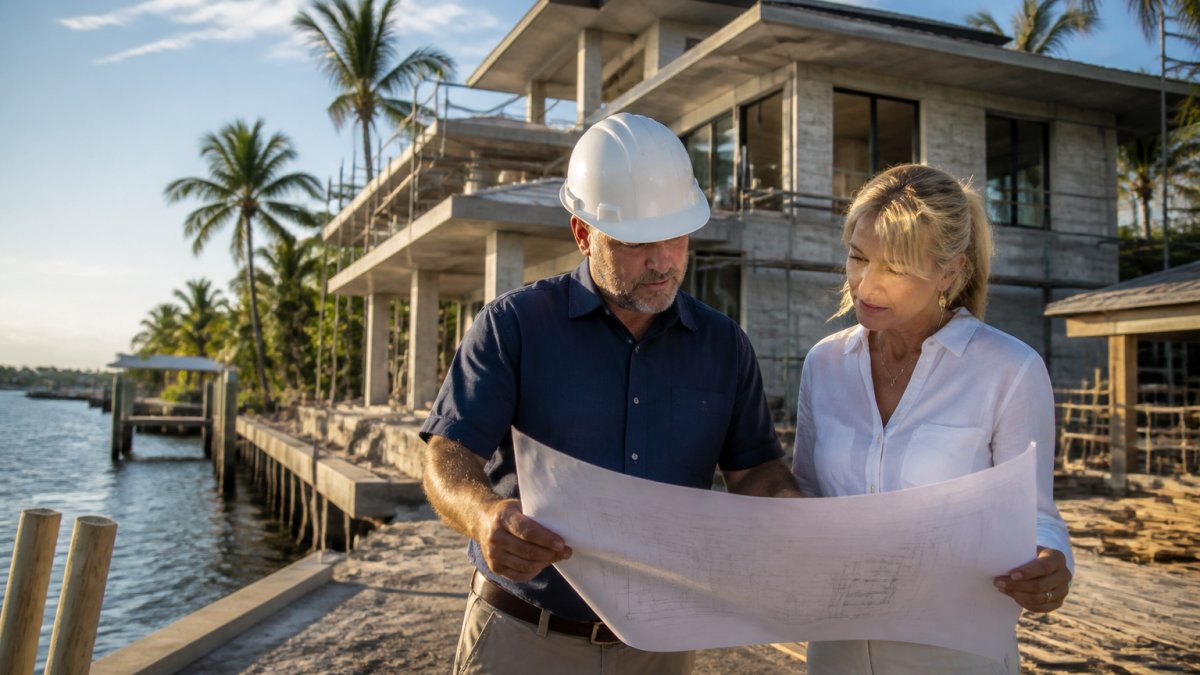
What that means in practice:
- Fixed-price contracts for most projects under $1.5 million, so your budget is defined before work starts
- Owner-led craftsmanship with direct involvement from John Pelland, not a handoff to a junior superintendent
- An on-time completion guarantee backed by self-imposed penalties, so deadlines carry real consequences
We are licensed and insured (CGC1519502) and have operated since 2005.
If you have been burned by a lowball estimate that grew through change orders, the fixed-price model is the direct answer.
Florida Department of Business and Professional Regulation contractor licensing lets you verify any contractor's license status before signing.
Frequently Asked Questions
What should I compare when choosing a luxury home builder?
Focus on three things: how the builder prices the project, who actually runs the job site, and what happens when something goes wrong. Ask whether they offer a fixed-price construction contract or cost-plus, confirm whether the owner or a hired superintendent manages daily work, and request written consequences for missed deadlines. A builder with 35+ years across every trade, like Accent Construction & Remodeling, can answer these directly because the founder stays involved from consultation to final walkthrough.
How do fixed-price and cost-plus construction contracts differ?
A fixed-price construction contract locks in your total cost before work begins, so the builder absorbs overruns unless you change the scope. Cost-plus bills you for actual materials and labor plus a markup, which means your final number can climb as the project unfolds. For luxury builds under $1.5 million, fixed-price gives you budget certainty. Ask any builder how they handle unexpected site conditions, because that answer reveals whether their fixed price is real or just a starting point.
How long does it take to build a custom luxury home?
Timelines vary by scope, permitting, and site conditions, but luxury home construction typically runs longer than standard builds because of custom finishes, architectural design reviews, and material lead times. The biggest variables are permit acquisition, HOA approvals for high-rise or waterfront properties, and how quickly decisions get made on selections. A builder who provides a written schedule with self-imposed penalties for missed deadlines gives you a timeline you can actually hold them to.
How can I check a contractor's references and past projects?
Ask for addresses or photos of completed projects from the last two years, then visit at least one in person. Talk to those homeowners about change orders, communication, and whether the builder finished on time. Also verify the license through your state's licensing database and confirm insurance coverage. Custom home builder reviews on third-party sites help, but direct conversations with past clients reveal how a builder handles problems, which matters more than a perfect portfolio.
High-end construction rewards homeowners who ask hard questions before the first shovel hits the ground. If you want a builder who locks the price, keeps the owner on site, and puts penalties behind every deadline, Accent Construction & Remodeling is built for exactly that. Get a free quote and see your project scoped, priced, and planned in 3D before you commit.